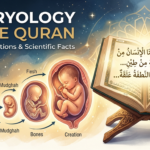
Modern Muslim apologists, including Dr. Al-Zeiny and Zakir Naik, claim that Quran 53:45–46 uniquely states that a baby’s sex is determined by the male sperm:
“He has created both sexes, male and female from a drop of semen which has been ejected.”
They present this as evidence of advanced scientific knowledge in the seventh century, contrasting it with earlier beliefs that the mother or both parents jointly determined sex.
Analysis of the Claim
This interpretation is recent. No classical Quranic commentator over fourteen centuries understood the verse as a statement about chromosomal sex determination. The verse simply notes that both males and females originate from ejected semen. It does not address the mechanism that decides whether the resulting child will be male or female.
Muhammad’s Own Statements on Sex Determination
In contrast to the modern reading, several hadiths attribute to Muhammad a different explanation.
In Sahih Muslim (Book of Menstruation), he is reported to have said:
“The fluid of the man is white and the fluid of the woman is yellow. When they meet and the man’s fluid prevails over the woman’s, a male child is created by Allah’s decree. When the woman’s fluid prevails over the man’s, a female child is formed by Allah’s decree.”
A parallel report in the same collection (and in Sunan Ibn Majah) adds that the man’s fluid is thick and white while the woman’s is thin and yellow, and that resemblance follows whichever fluid dominates.
These reports contain two clear scientific errors by modern standards:
- Female reproductive fluid (whether arousal fluid or the fluid released during orgasm) is not yellow.
- The sex of the child is determined by the chromosome carried by the sperm (X or Y), not by which parent’s fluid “prevails.”
Internal Contradiction
Another hadith in Sahih Muslim (Book of Destiny) presents a different account. After forty-two nights the angel is sent to shape the embryo and then asks Allah whether the child will be male or female; Allah decides according to His will. In this version sex determination is an independent divine decision, unrelated to the relative strength of male or female fluids.
Thus the prophetic reports themselves offer two incompatible explanations, neither of which matches the modern chromosomal understanding, and both of which differ from the recent apologetic reading of Quran 53:45–46.
Attempts to Reinterpret the “Yellow Fluid”
Some contemporary apologists suggest that the “yellow fluid of the woman” refers to the yolk-like centre of the ovum rather than visible discharge. This reading is difficult to sustain:
- The hadiths treat the fluids as visible and observable during intercourse or nocturnal emission.
- They describe the man’s fluid as thicker and the woman’s as thinner—properties that do not fit the relatively dense cytoplasm of an ovum.
- The same Arabic expression (māʾ al-marʾa) is used for the woman’s contribution in both contexts.
Modern assisted reproduction further undermines any fluid-dominance theory: a single sperm injected into an egg can produce a child who resembles both parents, without any mixing of visible reproductive fluids.
Conclusion
Quran 53:45–46 states only that males and females are created from ejected semen. It does not describe the chromosomal mechanism of sex determination. The detailed explanations attributed to Muhammad in the hadith literature rely on an outdated model of competing male and female fluids (one white, one yellow) or on direct divine decision after the embryo has already begun to form. Neither model corresponds to contemporary biology. The modern claim that the Quran anticipated the discovery of the sperm’s role in sex determination is a retrospective reinterpretation that is not supported by the classical exegetical tradition or by the prophetic reports themselves.