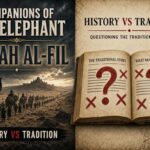
Islamic tradition identifies Surah 105 (al-Fil) with a specific historical event: the attempted attack on the Kaaba by the Yemeni ruler Abraha and his army of elephants in the year of Muhammad’s birth. According to later reports, Allah sent flocks of birds (abābīl) that pelted the army with stones, destroying it in answer to a prayer by Muhammad’s grandfather ʿAbd al-Muṭṭalib. The absence of contemporary pagan objections is often cited as confirmation that the miracle was widely known.
A closer examination of the Quranic text, the hadith literature, external historical sources, and logistical considerations reveals significant difficulties with this identification.
1. The Quran Does Not Name Abraha or the Kaaba
Surah al-Fil states only that the Lord dealt with “the companions of the elephant” by sending birds that struck them with stones of baked clay, leaving them like eaten-up husks. It mentions neither Abraha, nor an assault on the Kaaba, nor any prayer by ʿAbd al-Muṭṭalib. The connection to those specific details is supplied entirely by later tradition.
2. Absence from the Most Authoritative Hadith Collections
The major canonical collections (Bukhari, Muslim, and the other four of the Six Books) contain no rigorously authenticated report that explicitly links Surah al-Fil to Abraha’s campaign. Narrations attributed to Ibn Abbas exist, but they lack continuous sound chains. A public miracle of this magnitude, occurring in the generation immediately preceding Muhammad, would be expected to leave multiple independent eyewitness traces; their scarcity is noteworthy.
3. No Record of Conversions Based on the Event
The Meccan opponents repeatedly demanded miracles as proof of prophethood. Muhammad is never reported to have cited the destruction of Abraha’s army as such proof. The Quran itself records various explanations for the absence of signs (17:90–93, 17:58–59, etc.). If a spectacular, recent, and locally witnessed miracle had occurred, its absence from these exchanges is difficult to explain. No source records large-scale conversions among the Quraysh or others prompted by recollection of the elephant episode.
4. Internal Contradictions in the Narrative
Later accounts disagree on basic details:
- Number of elephants: an entire army, seventy, nine, or only one (sometimes named Maḥmūd).
- Timing relative to Muhammad’s birth: forty days, fifty days, ten years, twenty-three years, thirty years, forty years, or seventy years earlier.
Such variation is typical of material that crystallised long after the supposed event.
5. External Historical Silence
The sixth-century Byzantine historian Procopius, who wrote in detail about Abraha and South Arabian affairs, mentions no elephant expedition against Mecca and places Abraha’s death roughly a quarter-century before the traditional date of Muhammad’s birth. A Sabaic rock inscription recording Abraha’s campaigns in Arabia describes military successes, the taking of booty and prisoners, and a safe return; it contains no reference to elephants, birds, the Kaaba, or catastrophic defeat.
6. Logistical Improbability
Moving a force of African elephants approximately 500 miles across desert and mountain terrain from Yemen to Mecca faces severe obstacles. African elephants are difficult to domesticate, require hundreds of pounds of forage and dozens of gallons of water daily, and need regular moisture for their skin. No contemporary source records the necessary supply train or route infrastructure.
7. Religious Status of ʿAbd al-Muṭṭalib
Traditional reports depict ʿAbd al-Muṭṭalib practising divination with arrows before the idol Hubal. A well-known hadith in Sahih Bukhari records that Abu Talib, at his death, refused the shahada and affirmed that he remained upon the religion of ʿAbd al-Muṭṭalib. These details sit uneasily with later portrayals of him as a pure monotheist whose prayer alone prompted the miracle.
8. Alternative Possibilities
The phrasing of Surah al-Fil (“Have you not seen how your Lord dealt with the companions of the elephant?”) parallels the language used for the peoples of ʿAd and Thamud. Pre-Islamic Arabs already possessed a repertoire of destruction legends. It is possible that the surah alludes to an older, locally circulating story about a people associated with elephants, later retroactively identified with Abraha. Archaeological finds at Petra (including elephant motifs) have prompted some modern writers to explore links with Thamudic material culture, though this remains speculative.
9. Later Attacks on the Kaaba
After the establishment of Islam the Kaaba was attacked on several occasions (by al-Ḥajjāj, by the Qarmatians who removed the Black Stone, and in other incidents). No comparable avian intervention is recorded. This contrast raises questions about the selective nature of the claimed protection.
Conclusion
Surah al-Fil recounts a divine punishment of an elephant-owning force by birds that cast stones. The detailed story that identifies that force with Abraha’s army, dates it to the year of Muhammad’s birth, and links it to a prayer by ʿAbd al-Muṭṭalib is a product of later tradition. It is unsupported by the Quranic text itself, by the most authoritative hadith collections, by contemporary non-Muslim historiography, and by logistical and archaeological considerations. The narrative functions as a pious legend rather than as a verifiable historical event.