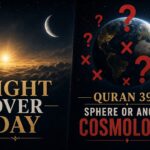
Quran 39:5 states:
“He created the heavens and the earth in truth. He wraps the night over the day and wraps the day over the night, and He has subjected the sun and the moon, each running for a specified term.”
Modern apologists, including Zakir Naik, interpret the Arabic verb yukawwiru (“wraps” or “coils”) as evidence that the Earth is spherical. They compare the overlapping of day and night to a turban wound around a head and argue that only a spherical Earth allows such continuous coiling.
A careful reading of the verse in its linguistic and cosmological context does not support this interpretation.
The Scope of the Statement
The verse begins by referring to the creation of “the heavens and the earth.” The subsequent description of night being wrapped over day and day over night is presented within that same cosmic framework. In the Quranic worldview, day and night are not limited to the surface of the Earth; they are treated as phenomena that affect the created order as a whole.
This broader conception appears more clearly in 79:27–29, which speaks of the heaven itself having its night covered with darkness and its day brought forth. The language treats day and night as alternating conditions of the sky, consistent with a model in which a single sun rises and sets for the entire cosmos.
Cosmology Implied by the Text
The Quran consistently speaks of one sun and one moon moving along appointed courses. When the sun is described as setting, night is understood to fall; when it rises, day returns. There is no indication of simultaneous day on one side of a globe and night on the other. The imagery of wrapping or coiling fits a picture in which light and darkness successively cover the same realm, rather than a rotating sphere illuminated on one hemisphere.
Classical commentators understood kawwara in the ordinary sense of folding or overlapping successive periods of light and darkness. They did not derive from it a doctrine of terrestrial sphericity.
Related Cosmological Claim: Twelve Lunar Months from Creation
Quran 9:36 states that the number of months with Allah has been twelve lunar months “since the day He created the heavens and the earth.” This claim presupposes that the lunar calendar operated from the beginning of the cosmos. Modern cosmology places the formation of the Earth and Moon billions of years after the origin of the universe, long after any system of months could have existed. The assertion reflects the limited astronomical knowledge of the seventh-century environment in which the text was composed.
Conclusion
Quran 39:5 describes the successive overlapping of night and day within a cosmos that contains a single sun and moon. The language is compatible with the pre-modern understanding that day and night alternate for the created order as a whole. It does not articulate the modern scientific concept of a spherical Earth rotating on its axis and producing simultaneous day and night on opposite hemispheres. The spherical-Earth reading is a later interpretive overlay rather than a feature of the text itself.