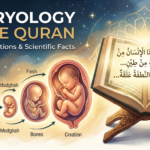
Modern Islamic apologists claim that the stages of human embryonic development described in the Quran and authentic Hadith match modern embryology with precision impossible in the seventh century, constituting a divine miracle. Critics respond that the descriptions contain clear scientific inaccuracies and closely parallel the pre-existing theories of Greek physicians such as Hippocrates, Aristotle, and Galen.
The Quranic sequence appears in verses such as 22:5 and 23:12–14: creation from dust, then a sperm-drop (nutfah), then a clinging clot (alaqah), then a lump of flesh (mudghah), then bones, then flesh clothing the bones. Hadith in Sahih Bukhari and Sahih Muslim supply a fixed timeline: forty days as nutfah, forty days as alaqah, forty days as mudghah, after which an angel breathes the soul and records the child’s sex, provision, lifespan, and destiny (total 120 days).
Stage 1: Nutfah (Days 1–40)
Classical understanding treated nutfah as a visible drop of semen. In reality the fluid component of semen disperses within minutes. Fertilization produces a zygote that becomes a blastocyst by day 5–6 and implants by the end of week 2. By week 3 the three germ layers have formed. The embryo is never a static “drop” for forty days.
Stage 2: Alaqah (Days 41–80)
Classical tafsīr uniformly rendered alaqah as a blood clot or congealed blood. By day 40 the embryo already possesses limb buds, a beating four-chambered heart, developing brain, liver, and kidneys, and distinct facial features. It is never a blood clot at any stage.
When microscopic evidence rendered the “clot” reading untenable, modern apologists redefined alaqah as “leech” (clinging and blood-sucking) or “leech-like” in appearance. Both redefinitions face difficulties:
- Nutrient exchange begins around day 14 via the placenta, not after day 40.
- The placenta, not the embryo itself, performs the attachment and exchange functions.
- Exchange is bidirectional, unlike a leech’s one-way feeding.
- Classical dictionaries (e.g., Lisān al-ʿArab) link the leech designation to colour and consistency of blood, not to shape or sucking behaviour.
- Visual comparisons typically use a 23-day embryo (when the neural tube is prominent) rather than a 40-day embryo, and often invert the orientation so the thick cephalic end of the embryo is aligned with the thick posterior sucker of the leech.
Stage 3: Mudghah (Days 81–120)
Classical meaning is a lump or morsel of flesh. By day 80 the fetus has a recognisable human form, ossifying skeleton, and functional organ systems; it is not an undifferentiated lump. The modern claim that mudghah means “chewed substance” (because somites supposedly resemble teeth marks) fails on linguistic, anatomical, and chronological grounds:
- Somites are convex blocks that become vertebrae and muscle; they are not concave bite marks.
- The Prophet himself used mudghah for the heart and for the genitals—structures that do not resemble chewed gum.
- Somites are prominent around day 25, long before the Hadith timeline places the mudghah stage.
Stages 4–5: Bones then Flesh
The Quranic sequence places bone formation after the mudghah stage and the clothing of bones with flesh still later. Hadith chronology therefore locates these events after day 120. In reality cartilage models and muscle precursors appear between days 25–42 and develop in parallel; ossification begins around week 9 while muscles are already functional. The Arabic term used is ʿaẓm (hard bone), not ghuḍrūf (cartilage). Both the sequence and the terminology conflict with observed development.
Soul and Sex Determination
Hadith state that the soul is breathed in at 120 days and that sex is decided by an angel at either 42 or 120 days. Biological life begins at fertilization; a heartbeat is present by day 22; sex is fixed by the chromosomal content of the fertilizing sperm at the moment of conception. Differentiation of external genitalia around week 6–7 is the expression of a genetic decision already made, not a new determination.
Historical Sources
The four-stage scheme (semen → blood-like → flesh → bones clothed with flesh) reproduces the embryological theories of Hippocrates, Aristotle, and especially Galen, whose works formed the core curriculum at the Academy of Jundishapur. The contemporary Arab physician al-Ḥārith ibn Kalada is reported to have studied there. Macroscopic observation of miscarriages and animal dissections readily produces the impression of a blood clot, then a formless lump, then hard structures appearing within soft tissue—precisely the sequence preserved in the Islamic sources.
Conclusion
The Quranic and Hadith descriptions of embryonic stages do not match the timeline, morphology, or sequence established by modern embryology. The classical meanings of alaqah and mudghah are scientifically inaccurate; the modern redefinitions require chronological and anatomical adjustments that contradict the very texts they seek to defend. The overall scheme is continuous with Greek medical theory current in the Near East centuries before Islam. Claims of miraculous scientific foreknowledge therefore rest on selective reinterpretation rather than on the plain sense of the sources or on empirical observation.