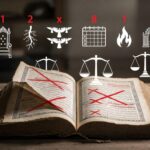
The Quran contains numerous internal contradictions across narrative retellings, theological claims, descriptions of Allah, the afterlife, creation, law, and human responsibility. These inconsistencies appear in sequence, wording, numbers, and core assertions. The points below present the contradictions in plain language with the relevant verses.
1. Repeated Narratives That Diverge
Several stories are told more than once across different surahs, yet the retellings disagree on sequence, details, or wording.
- Adam’s expulsion: Allah issues the “descend from paradise” command twice (2:36 and 2:38). The timing of Adam’s forgiveness relative to the expulsion differs between Surahs 2, 7, and 20 (2:36–39, 7:22–25, 20:121–124).
- Noah’s shipbuilding instructions: In 11:40 Noah receives loading instructions when the flood arrives; in 23:27 he receives essentially the same instructions much earlier, alongside the command to build the ark (11:37–40, 23:27).
- Abraham smashing the idols: Surah 37 presents a continuous confrontation at the idols’ location; Surah 21 has the crowd leave, discover the wreckage, then send for Abraham (21:57–68, 37:87–97).
- Abraham’s angelic guests: Details differ on when Abraham’s fear is triggered, whether his wife hears the good news directly or indirectly, and whether the tidings concern one son or both Isaac and Jacob (11:69–79, 15:51–60, 51:24–34).
- Lot and the angels: The order of events (mob’s arrival versus angels revealing their mission; Lot’s exact wording to the crowd) differs between accounts (11:77–83, 15:61–74).
- Response of Lot’s people: Two verses each claim, in exclusive language, that the only thing Lot’s people said was one specific statement — yet the two verses report different statements (27:54–57, 29:28–29).
- Moses at the burning bush: The exact wording and sequence of Allah’s self-introduction differ across three tellings (20:10–16, 27:7–9, 28:29–30).
- Moses’s fears about Pharaoh and Aaron: The order in which Moses raises his fear of disbelief, his speech difficulty, and his fear of retribution is reversed between accounts (26:10–17, 28:33–35).
- Moses and Aaron’s introduction to Pharaoh: Different titles are used (“your Lord” versus “Lord of the worlds”) in parallel first-encounter scenes (20:47–49, 26:16–23, 7:104).
- Pharaoh and his council: In one telling Pharaoh asks his council for advice; in the parallel telling the council asks the same question (7:109–112, 26:34–37).
- Who believed in Moses: Three surahs say the magicians believed after Moses’s miracle; Surah 10 says only some youths believed, without describing a miracle (26:38–51, 7:113–129, 20:60–76, 10:80–86).
- Pharaoh’s army and the sea: Some verses describe the sea “covering” the pursuing army after they followed on a dried path; others say Allah “threw” or “cast” the army into the sea (10:90, 20:77–78, 26:63–66, 28:40, 51:40).
- Aaron and the golden calf: Aaron gives two different justifications to Moses in the parallel scenes (7:150, 20:90–95).
- Moses’s speech impediment: Moses asks Allah to fix his speech impediment and is told his prayer is granted, yet Pharaoh later says Moses still cannot express himself clearly (20:24–28, 20:36, 43:52).
- Destruction of Thamud: One verse says the people will “know tomorrow” that Salih is not lying; another says destruction came three days after they harmed the she-camel (54:26, 11:64–68, 91:11–15).
- Destruction of ‘Aad: One verse groups ‘Aad with Thamud as destroyed by a “thunderbolt,” while other passages describe ‘Aad’s destruction by a multi-day wind (41:13–17, 46:24–25, 51:41–45, 54:18–20, 69:4–8).
- Annunciation to Mary: One version has a single angel/messenger visit Mary; the parallel version uses the plural “the angels” (19:17–20, 3:45–47).
2. Allah’s Nature and Attributes
- Location: Some verses describe Allah seated on a throne; others describe Him as everywhere or nearer than the jugular vein (2:255, 57:4, 11:7, 2:115, 2:186, 50:16).
- Visibility: Some verses state no vision can grasp Allah; Surah 53’s night-journey account is widely read as a direct sighting of Allah (6:103, 42:51, 53:1–18).
- Could Allah have offspring: One passage says it is impossible because Allah has no consort; another argues rhetorically that Allah could choose a son if He wished but does not (6:100–101, 39:3–4).
- Mercy versus severity: Allah is described as “Most Gracious, Most Merciful,” yet also as continually renewing the skin of unbelievers so they keep feeling the fire’s pain (1:3, 4:56).
- Forgiveness of shirk: Some verses state Allah does not forgive associating partners with Him; others describe forgiveness after golden-calf worship or repentance from major sins (4:48, 4:116, 4:153, 25:68–70).
3. Angels and Messengers
- Angels at Badr: One verse says three thousand angels were sent; another says one thousand (3:124, 8:9).
- Can angels be messengers to humans?: One verse suggests angels would not be sent as messengers to a peaceful settled people; another says only men were sent as messengers; a third says Allah chooses messengers from both angels and men (17:95, 12:109, 22:75).
4. Creation
- Heaven or Earth first: One passage lists heaven’s creation before earth’s; others describe the earth being created first, with heaven fashioned afterward (79:27–33, 2:29, 41:9–12).
- How many days: One verse says six days; another, read arithmetically (2+4+2), totals eight (10:3, 41:9–12).
- Instant versus gradual creation: One passage emphasizes six days; another emphasizes Allah simply saying “Be” and it is (7:54, 2:117).
5. The Day of Judgment
- Will the condemned be able to speak?: Several verses flatly deny it; others describe extensive dialogue, pleading, and lying; one offers a middle position where mouths are sealed but limbs testify (27:85, 77:34–38, 6:22–24, 37:20–28, 36:65).
- Will they be raised blind?: One passage says yes for those who ignored Allah’s remembrance; others depict clear-sighted dialogue (20:124–125, 16:76, 37:16–20).
- How long will it feel like they were on Earth?: Answers vary between an afternoon or morning, an hour, ten days, or a day or part of a day (79:46, 30:55–56, 20:102–104, 23:112–114).
6. The Source of Evil
- Does evil come from Allah?: One verse states all things — implicitly including evil — come from Allah; the very next verse says good comes from Allah while evil comes from the person themself (4:78, 4:79).
7. Heaven and Hell
- Intercession: Some verses flatly deny any intercession will be accepted; another allows intercession for those Allah permits (2:47, 2:123, 20:109).
- Is hell eternal for non-Muslims?: Some verses qualify punishment with “except as your Lord wills” or describe a finite span of “ages”; others describe it as an eternal, permanent home (6:128, 11:106, 78:23, 2:167, 41:28).
- Food in hell: Described variously as bitter thorny plants, pus/wound discharge, and the zaqqum tree (88:6, 69:36, 37:62–66).
- Bracelets in paradise: Described as silver in one verse, gold in another, and gold-and-pearl in two others (76:21, 18:31, 22:23, 35:33).
8. Human Responsibility
- Bearing others’ sins: Several verses state firmly that no soul bears another’s burden; others describe people bearing added burdens for misleading others, or being held to account for killing past prophets. Abel also states in 5:29 that he wants to transfer his sin onto Cain (6:164, 17:15, 35:18, 16:25, 2:91, 3:181, 3:183–184, 29:13, 5:29).
- Who takes souls at death: Described as a single Angel of Death, multiple angels, or Allah directly (32:11, 47:27, 39:42).
9. Practice and Law
- Alcohol: The stance progresses from calling it a “wholesome” fruit product, to restricting only prayer-time drunkenness, to calling it Satan’s handiwork to be avoided, to calling it a “great sin” with some benefit (16:67, 4:43, 5:90, 2:219).
- Eating non-Muslim food: One verse permits eating food prepared by Jews and Christians; another requires that Allah’s name be pronounced over the meat (5:5, 6:118).
- Sacred months: One verse says four months are sacred; another refers to “the sacred month” in the singular (9:36, 5:2).
- Fair treatment of multiple wives: One verse assumes a man can marry up to four “if you can deal justly”; another says you will never be able to deal equally between wives “however much you wish” (4:3, 4:129).
10. Compulsion, Tolerance, and the Treatment of Others
- Compulsion in religion: “No compulsion in religion” and “to you your religion, to me mine” are contrasted with commands to fight polytheists after the sacred months expire (unless they convert) and to fight People of the Book until they pay the jizyah (2:256, 109:6, 9:5, 9:29).
- Christians as allies or not: Christians are described as allies of the Jews and not to be taken as allies, yet elsewhere as nearest in love to believers and possessing compassion (5:51, 5:82, 57:27).
11. Textual and Miscellaneous Points
- Who delivered revelation to Muhammad: Described as “the Holy Spirit” in one verse and the angel Gabriel in another (16:102, 2:97).
- Is the Quran fully clear?: Several verses call it a clear, detailed explanation; one explicitly divides it into clear (“decisive”) and “allegorical” verses whose full meaning only Allah knows; another opens with disconnected letters of debated meaning (11:1, 16:89, 6:114, 12:111, 3:7, 2:1).
- Weaning period: One verse describes pregnancy plus weaning together totaling thirty months; another gives weaning alone as two years (46:15, 31:14).
- Inheritance shares: The shares assigned to siblings in one passage (a sixth each, or a third split among several) do not match the shares assigned in another (half for a lone sister, two-thirds for two-or-more sisters, double share for a brother). Combined family shares can exceed 100 percent (4:11–12, 4:176).
- The moon-splitting miracle: One passage is widely read as describing a miraculous splitting of the moon, while several other verses have Muhammad explicitly stating he can produce no miraculous sign, only warnings (54:1–2, 13:7, 6:109, 11:12, 10:20, 21:9).
12. Canonical Reading Variants (Qira’at)
The ten canonically accepted oral reading traditions occasionally diverge from each other in ways that change meaning — for example, a first-person versus second-person verb form in 17:102 (“I have already known” versus “you have already known”). Islamic doctrine holds all ten readings to be equally authentic transmissions from Muhammad.
These contradictions span narrative consistency, theological coherence, numerical claims, legal rulings, and descriptions of the divine. They remain unresolved by the text itself.