Introduction: A Bloody Dawn We Have Forgotten
The Partition of 1947 is that wound in Indian history which still groans every August. But our “secular” textbooks and “leftist” historians have always hidden one thing—or at least blurred it—namely, who was killed the most in that bloodshed, and who killed whom.
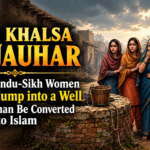
Toha Khalsa of Rawalpindi is that village where, in 1947, 93 Hindu-Sikh women collectively gave up their lives by leaping into a well—so that they would not fall into the hands of Muslim looters. This is called ‘Jauhar’—that rite of the Rajput tradition in which women jumped into fire or into a well to save their honour. The same happened in Toha Khalsa, except it was 1947, and the enemy was not Mughal or Turk, but the modern “Muslim League” and its lashkar (mob-army).
As an Indian Muslim, I want to ask here point-blank: Are we Muslims ready to look at that face of ours which Hindus and Sikhs saw in 1947?
—
Toha Khalsa: What Exactly Happened
Toha Khalsa now falls in Punjab, Pakistan, in the Rawalpindi district. In 1947 it was a Sikh-majority village, with a few Hindu families also living around it. When communal riots erupted in Punjab in March 1947, systematic attacks on Hindus and Sikhs began in Rawalpindi and the surrounding areas—which were going to “Pakistan.”
The villagers of Toha Khalsa resisted firmly at first. But as the lashkar kept growing, ammunition ran out, and the siege tightened from all sides—the village elders took that decision which Rajputs had been taking for centuries.
First, the children and the elderly were lowered into the well. Then the women jumped in, one by one. According to reports, around 90 to 93 women performed jauhar. In some accounts it is said that when there was no room left to jump into the well, the remaining women began to weep—out of the fear of what would happen if they were caught alive.
Later, the remaining Sikh-Hindu men who fought were martyred. And of the women who survived, many were later “brought back”—but that is another story, which I will touch upon later.
—
What is ‘Jauhar’, and Why Did It Become Necessary for Hindu-Sikh Women?
To understand this, we must come directly to that aspect of Islamic history which Muslim historians usually teach with “pride,” but speak less about its other side.
The tradition of jauhar took organized form in India only after the Muslim invasions. The reason is straightforward: when a victorious army captured a city, the defeated men were killed—but the women were often taken away as slaves, for the harem, or as loot. Where these Muslim wolves would rape those women day and night, and then sell them off to other men.
– In Mahmud of Ghazni’s invasions, thousands of women were looted along with the temples.
– After Muhammad Ghori, during the Delhi Sultanate, the chain of harem and slavery became institutionalized.
– In Timur’s (1398) attack, there was a qatl-e-aam (general massacre) in Delhi, and thousands of women were taken away as slaves.
It is from this historical experience that jauhar was born. This was not the Hindu woman’s “self-surrender,” but a conscious decision—that “if victory means slavery, then death is better.”
In 1947, the women of Toha Khalsa did exactly this. And here is one thing worth noting: these were Sikh women, who had no direct historical connection with jauhar. But the circumstances of 1947 forced them too to choose the same path that their Hindu sisters had chosen for centuries. This is India’s shared civilizational memory.
—