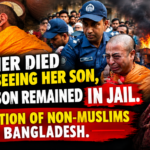
A Mother Died Without Seeing Her Son, While Her Son Remained in Jail
In the second week of September 2026, a 70-year-old woman, Sandhya Rani Dhar, died at a hospital in Hathazari, Chattogram.
Her last wish was simple — to see her son’s face one more time.
Her son was alive. He was simply in jail. The family repeatedly appealed for permission to let him meet his mother. According to reports, permission was not granted. The woman died with that wish unfulfilled.
Then, following an application by her other son, Chattogram District Commissioner Mohammad Zahidul Islam Mia granted him five hours of parole. The prisoner — Chinmoy Krishna Das Brahmachari, spokesperson for the “Bangladesh Sammilito Sanatani Jagaran Jote” — went to Hathazari, attended his mother’s funeral, and returned to jail within the stipulated time.
According to reports, before returning, he fell at the feet of the Radha-Krishna idols at Pundarik Dham and broke down in tears.
Five hours. For a mother. In the middle of two years of imprisonment.
This is the same Bangladesh where nearly 90 percent of the population is Muslim, and whose Constitution claims secularism.
The Facts: Two Years, and a New Wall at Every Turn
If anyone thinks this is merely an emotional story, look at the record. This is a case in which bail is granted again and again, yet his release keeps getting delayed.
Das’s lawyer, Supreme Court advocate Apurva Kumar Bhattacharya, a former Deputy Attorney General of Bangladesh, says that Das calls him from jail every Saturday and that his health is deteriorating. Whenever these hearings take place, the court premises are turned into a fortress, with the army, BGB, RAB and thousands of police personnel deployed — because crowds gather outside, accusing Das himself of being responsible for the murder of the lawyer.
Throughout this entire period, remember one thing: Das was arrested in 2024 during Muhammad Yunus’s interim government, while the denial of parole to see his mother in 2026 took place under Tarique Rahman’s BNP government. In other words, this is not a matter of party politics. It is a matter of the system.
The Awami League called the denial “extreme cruelty.” India’s Ministry of External Affairs had expressed deep concern over his arrest. The matter was also raised in the British Parliament.
Who Is the Man Whose Mother Died?
Chinmoy Krishna Das, whose birth name is Chandan Kumar Dhar, is a Gaudiya Vaishnava monk and the head of Pundarik Dham in Hathazari. He is the spokesperson for the “Bangladesh Sammilito Sanatani Jagaran Jote” — a platform that raises its voice for the rights of minorities.
He was a member of ISKCON. In July 2024, the organisation expelled him for violating organisational discipline. ISKCON Bangladesh later made it clear that his statements and programmes were not those of the organisation, although it supported his voice for the rights of Hindus.
In August 2024, the Sheikh Hasina government fell. After that, Hindu homes, shops and temples in Bangladesh came under attack — Reuters, the BBC and minority-rights groups documented these attacks. Chinmoy Das took to the streets during this period.
On October 25, 2024, a large rally was held at Chattogram’s historic Laldighi Maidan. Eight demands were presented — a law for minority protection, a ministry for minority affairs, a special tribunal for speedy trials of cases involving persecution of minorities, and legislation to restore temple land. Read the list of demands — there is not a single demand in it that would constitute “treason” in any civilised country.
One Flag, One FIR, and a Dead Lawyer
The allegation was that during the same rally at Laldighi, some young people hoisted a saffron flag above the national flag of Bangladesh at an independence monument — and that this amounted to treason.
On October 31, 2024, a local BNP leader, Firoz Khan, filed a case against Das and 18 others. Interestingly, the BNP later expelled Firoz Khan from the party because he had filed the case without informing the party.
On November 22, 2024, at another gathering in Rangpur, Das condemned the growing attacks on Hindus. Three days later, on November 25, he was arrested at Hazrat Shahjalal International Airport in Dhaka and handed over to the Chattogram Metropolitan Police.
On November 26, 2024, a Chattogram court rejected his bail application. Violence erupted outside the court premises. During that violence, 32-year-old Saiful Islam Alif — a government lawyer in the case against Das — was surrounded and hacked to death by a mob. Das had said on that very occasion that his supporters were not against the state and that they would protest peacefully.
The murder of the government lawyer was itself a crime, and there is no proof that Das was responsible for inciting it.
“Five Hours” Is the Language of Islamic Law
In Islamic jurisprudence, non-Muslims are referred to as dhimmis — people who are permitted to live in a Muslim state as protected subjects, rather than by virtue of equal rights. The protection of a dhimmi is described as mercy, not a right. His life, property and place of worship all depend upon the “generosity” of the state.
And where something is treated as mercy, it is measured out.
Understand this, and the mathematics of “five hours” becomes clear on its own. Classical books of Islamic jurisprudence prescribe, in measured detail, things such as permission for a dhimmi to travel for six days, the height of his room, the type of belt he may wear, and riding a mule instead of a horse. The “five hours” of parole granted at the time of his mother’s death is the child of the same mentality: it is mercy, it is permission, it is something lent to you.
In a country whose Constitution guarantees freedom of religion, permission to see one’s mother should not be a matter of “permission” at all. But in a country created on the basis of religion, concepts such as freedom and humanity become meaningless.
Prayer Is Legal, Questioning Is a Crime
The person demanding a minority-protection law is being portrayed as a traitor. Now look at the other side — Bangladesh has also used blasphemy laws to imprison people who questioned Islam. International reports such as the Freedom of Thought Report have documented how blasphemy and apostasy-related laws in Bangladesh have been used as powerful legal tools.
In other words: one set of laws for those who leave Islam, and another for those who speak out about the suffering of being a minority. This has been the character of all Islamic countries throughout history.
Tears for Palestine, Silence for Dhaka
OpIndia has hit the bull’s-eye with a post, and the point it makes is this — those who post Instagram stories about Gaza every day, when will their voices be raised for the Hindus of Bangladesh?
I would take this question even further. This silence is not an accident; it is a choice. When a minority is dying in a Muslim-majority country, it is not even considered news. But when Muslims are dying in a non-Muslim-majority country, it becomes a “question of humanity.” There are two different scales of sympathy, and the value assigned on those two scales is different.
This has become the mindset of all those who follow the religion of Islam and of all leftists.
From 22 Percent to 8 Percent
The numbers speak for themselves. In the 1951 census, Hindus constituted 22 percent of the population of East Bengal. In 1991, it was 15 percent; in 2011, 8.5 percent; and in the 2022 census, approximately 7.9 percent — around 13.1 million people. In other words, over seventy years, a community has been reduced to roughly one-quarter of its former share in its own homeland.
This is not the result of some “natural” demographic change. It is the story of looting, land grabs, destruction of temples and the millions of people who decided that crossing the border was a better option. Some reports have also claimed that extremist mobs attempted to impose collections resembling jizya — these claims require independent verification, but the census figures stand on their own.
In a country where the presence of a community has declined over seventy years, imprisoning the spokesperson of that community is not simply “following the law”; it is a form of lynching carried out through courts and legal proceedings.
The Final Word
Sandhya Rani Dhar is no more. Her son is still in the same jail. The next hearing is on September 17, and before that, the Chattogram court will once again be turned into a fortress. Because an entire mob of jihadists will be ready to lynch him.
The Hindu in Bangladesh still lives in his own home like a dependent — with permission to live, but without rights. He is allowed to build a temple, but on the condition that he remain silent when that temple is burned.
And in this entire story, the most painful sentence is not that the mother died. The most painful sentence is that before she died, she had to ask:
“Can I see my son?”
In a country where such a question has to be asked, the answer is “No.” A country where such a question never needs to be asked — that is a country that is truly free.
Sources / References
- OpIndia, September 11, 2026 — “The nearly two-year ordeal of Chinmoy Krishna Das behind bars” (timeline and details of the case)
- Navbharat Times / NDTV / India Today / The Statesman / IANS, September 9–11, 2026 (reports concerning his mother’s death, parole and the five-hour release)
- Wikipedia — “Chinmoy Krishna Das,” “2024 Bangladesh anti-Hindu violence,” “2026 Bangladeshi general election” (background)
- Minority Rights Group and Bangladesh census figures for 1951, 1991, 2011 and 2022 (Hindu population percentages)
- Freedom of Thought Report (Bangladesh) — regarding blasphemy and apostasy-related laws
Note: This article is an analysis based on news reports. The case is pending before the court, and the charges against Das have not been proven.